You're already ahead of most people who book a call.
The last 30% is this page. People who arrive prepared get their own numbers and their own plan on the call, not an introduction. Read through the eight sections below.
Finish the last 30% ↓ 8 sections · about 12 min“Why do telehealth businesses fail?”
It's rarely the market. The build is a solved problem. These businesses fail on a handful of things nobody warns you about, usually right when they start working. Here's each one, and how we make sure it doesn't happen to you.
Assembling the pieces yourself
Finding a doctor network isn't hard. Finding a pharmacy isn't hard. Getting the two licensed in the same states and passing orders to each other without breaking is. When it fails, it fails after patients have paid and are waiting on medication.
A network that's already paired
Your brand plugs into a licensed partner network: providers in all 50 states and US 503A compounding pharmacies, already integrated with the patient platform, checkout and refill billing.
Advertising before you're allowed to
Prescription products sit in the most heavily policed corner of paid media. One wrong claim, or a tracking pixel on a page with medical questions, and the ad account is gone. Not warned. Gone.
Certification first, then ads
LegitScript is the gatekeeper Meta and Google use for healthcare advertising. We start it in week two, build your site and claims to pass it, and no ad runs until it clears.
Taking payments on the wrong processor
Most mainstream processors prohibit prescription sales. You don't get declined at sign-up. You get approved, run volume, then get frozen months in, with all your revenue flowing through that account.
A checkout built for prescriptions
Patients pay through a HIPAA-compliant checkout under your brand that is built for this category. Never Stripe, never Whop.
Patients who cost more than they're worth
Anyone can generate leads. The standard way to fail is winning patients with a cheap front-end offer and having no margin left to buy the next one.
We run the acquisition
Offer, pricing, creative, media buying and the follow-up flows are ours to run. It's the lever that decides whether the other numbers matter, so we don't hand it to you.
Launching underfunded, then going quiet
Owners who pause ads in month two, sit on approvals for weeks, or rewrite offers that are working. The launch drags and the momentum is gone before it starts.
We only take people who are ready
We qualify on capital and commitment before the call, tell you the real ad budget up front, and meet with you weekly so nothing stalls.
“If it's so good, why don't you just run one yourselves?”
Fair question. Four straight answers.
See one running.
Don't take our word for the system. Open a live store built on it, click through the programs, start an intake and see exactly what your patients would see.
Patient acquisition is our trade.
We didn't start as a telehealth setup company. We're built off the back of Aesthetic Acquisition, a marketing company that has spent five years filling clinics with patients for medical weight loss, peptides and anti-aging treatments. That is the hard half of this business, and it's the half we own.
One brand has a ceiling. A portfolio doesn't.
Every brand we run adds data on what converts, at what cost, in which state. That makes the next launch sharper than any single operator could manage alone, and every brand runs under its owner's name, not ours.
We're paid a flat fee, never a share.
We don't take a percentage of your revenue. We earn by building it well and by you keeping us on because it works. We cap new builds at 10 a month so month three gets the same attention as month one.
The question assumes building and operating are the same skill. We'd rather be very good at one side and have you own the other.
How does a telehealth brand compare?
Most ways to build an income ask for heavy capital, a lease and staff, or give you little control. A telehealth brand is a subscription business where the product happens to be prescription medication.
| Vehicle | Capital needed | Staff and premises | Reach | Recurring revenue | Control |
|---|---|---|---|---|---|
| Property | High ($100k+) | None | One location | Low | Medium |
| Franchise | Very high ($200k+) | Lease, fit-out, team | Local | Medium | Low |
| In-person clinic | High | Rooms, equipment, clinicians | Driving distance | Medium | High |
| Telehealth brand Best fit | $35k build + ad budget | None | National from day one | Monthly refills | High. You own it |
One patient, one month.
People ask how much they'll make. We won't give you a number, because anyone who does is guessing. Here's what one patient looks like instead, so you can run it yourself.
There's no appointment and no calendar to fill. A licensed provider reviews a written intake, the pharmacy ships, and the plan renews monthly. The same setup handles 50 patients or 500 without you hiring anyone.
| Example: semaglutide program | Per month |
|---|---|
| Patient pays | $299 |
| Medication and shipping | $60–110 |
| Provider consult | about $15–25 |
| Processing and platform fees | about $10–25 |
| Left before ads | about $140–210 |
Cost per paying patient
Ad spend divided by new patients who paid. Not leads.
First order value
What the patient pays on their first order.
Contribution
What's left after medication, shipping and the provider fee.
Months retained
How long the patient keeps paying. Patients typically stay 3 to 6 months.
Price, minus cost, times retention, minus acquisition cost. That's the whole business on one line, and on the call we build it with your numbers.
This is an example with ranges, not a forecast. Results vary and aren't guaranteed. It leaves out our fee, ad spend, insurance, LegitScript renewal, labs and refunds, all of which are set out in section 08.
What your brand can offer
- Weight: semaglutide and tirzepatide, compounded for each patient by a US 503A pharmacy
- Men's health: TRT and ED
- Hormones: HRT
- Wellness: NAD+, sermorelin, glutathione, B12
- Hair and skin
Weight loss is the front door. The business is the patient relationship that follows it. We map your exact menu and pricing during the build.
What we won't build on
- Research peptides such as BPC-157, TB-500, CJC-1295 or ipamorelin
- Unapproved drugs such as retatrutide
- Anything sold as “research use only” or “no prescription required”
These cost brands their certification, their payment partners and their ad accounts. If someone offers to build your business on them, that tells you how carefully they've built theirs.
“But I'm not a doctor.” Most owners aren't.
In most states a company owned by non-doctors can't practice medicine. That's real, and it's why people assume this is closed to them. It isn't. It means the business is built as two parts instead of one.
Runs the business
- A US LLC, owned outright by you
- Owns the brand, domain, website, ad accounts and customer list
- Sets retail prices and receives payouts
- Needs no medical license
Practices medicine
- Providers licensed in each patient's state
- Decides who qualifies and what's prescribed
- Holds the medical records
- Carries its own malpractice cover
Builds and connects it
- Holds the partner network relationship
- Builds your site, funnel and checkout
- Handles compliance setup and review
- Runs your marketing
You own the business. Doctors do the medicine. Neither side owns the other.
You stay on your side of the line: you run the brand and the marketing, and you never decide who gets treated or what they're prescribed. This is general information about how US telehealth businesses are commonly set up, not legal advice. Rules vary by state, and we recommend having a healthcare lawyer review the structure for the states you plan to serve.
What your patient sees
They find you
An ad on Facebook or Instagram leads to your branded site, where they pick a program.
Intake and checkout
A few minutes of medical questions, the same ones a doctor would ask in person, then checkout under your brand.
A licensed provider reviews it
Usually without a live call. Video visits happen where a state or a medication requires one. Most patients are approved; some are declined for medical reasons, and that decision is always the provider's.
The pharmacy ships
An approved prescription goes to a US compounding pharmacy and ships to the patient's door.
It renews monthly
Refill reminders, check-ins and rebilling run automatically for as long as they stay on treatment.
You never speak to a patient, touch medication, make a clinical decision or handle support.
From signed to live in 30 to 45 days.
Thirty days is the target. Thirty to forty-five is realistic. LegitScript is the biggest variable and slow paperwork is the second. If someone promises you patients in four weeks, they're either not running paid ads or running them before certification clears.
Your part is small, and it's real
A handful of onboarding calls and the decisions only an owner should make: what it's called, how it's positioned, what you lead with and what you charge.
The capital
The build itself, and the ad budget that brings patients in. That's the real requirement, and section 08 lays out every dollar.
Run it as designed
You're buying a system that already works. The people who do best don't improvise on the parts they haven't done before.
The part we're actually known for.
Most telehealth setup companies build you something legally sound and leave you to fill it. We become your marketing team, because a perfect build with no patients is still a failed business.
Built to convert
An attraction offer, a core program and a downsell, priced so each patient is worth more than they cost.
New angles, constantly
Creative fatigues fast in this category. We ship new ads continuously, each one checked against what you're allowed to claim.
Nobody slips through
Every click is tracked to checkout. Email and text flows bring back the people who started and didn't finish.
Patients who stay
Refill reminders and check-ins. The money in this business is patients who renew month after month.
We run ads primarily on Meta (Facebook and Instagram). Your ad spend is paid by you, directly to the platform, from your own ad accounts. We don't mark it up and it never passes through us.
Hear it in their own words.
Clinic owners on what changed once our team took over their growth.
“69 new patients in 60 days”Kasey
“26 new patients in 30 days”Rose
“35 new patients in 30 days”Kara
“70% package upsell rate from the new clients we brought her”Will
“35 new patients in 30 days”Jenyce
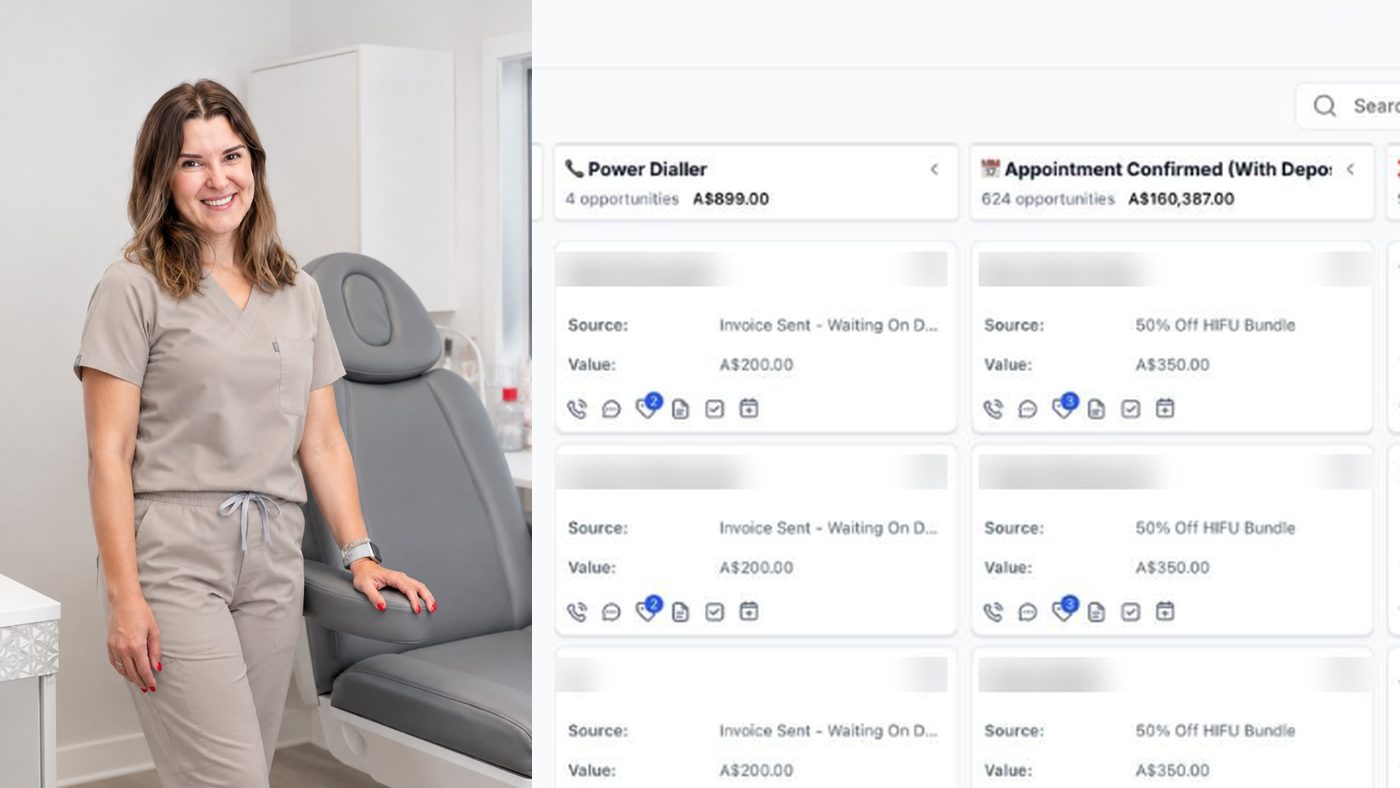
“$200K+ in 90 days”Slimming Sculpt Studio
Client stories are individual results. They are not typical and they are not a promise of what you will achieve.
What could this look like for you?
Drag the sliders and see the month-by-month picture. It's arithmetic on the assumptions you choose, not a forecast or a promise. Have a play, then see exactly what it costs to build in the next section. Bring your version to the call and we'll go through it together.
Every cost, on one page. No surprises on the call.
What unsettles people isn't the build fee. It's finding out about the next cost after they thought they knew the price. So here is all of it.
| Cost | Paid to | What to expect |
|---|---|---|
| The partnership | Us | $35,000. Covers the build, the platform and our marketing for months 1 to 6. |
| Monthly fee from month 7 | Us | $5,000 a month if you keep us running it. Flat fee, no revenue share. |
| Ad spend | Meta, from your card | Your budget, your accounts. Plan on about $20,000 you can put toward ads over the first few months. |
| Per-patient medical costs | Passed through at cost | Provider consults, medication and shipping. No markup, itemized. Only incurred when a patient has paid you. |
| Processing and platform fees | Deducted from payouts | At the partner's current rates, shown on every payout statement. |
| Business insurance | Your broker | General liability and cyber cover. Budget about $3,000–5,000 a year. |
| LLC and state fees | The state | Filing fees to form your company. |
| LegitScript renewal | LegitScript | Year one is covered. Renewal is yours from year two. |
| Labs | The lab partner | Only where a program needs them, such as TRT. |
Exact figures for your build are confirmed on the call and in your agreement. If the agreement and this page ever differ, the agreement is what counts.
A straight word on budget
You want about $20,000 you can actually access for ads, on top of the build or a deposit and payment plan. If that isn't realistic right now, tell us before the call. We'd rather you kept your money than started underfunded, because that's the one version of this that doesn't work.
Built for you, then filled with patients.
One partnership. We build the whole business and run the marketing for your first six months.
Six-month partnership. Build, platform and marketing included for months 1 to 6.
From month 7: $5,000 a month if you keep us running it. Flat fee, no revenue share.
Your ad spend, your accounts. Paid by you straight to Meta. You own the brand, the patients and the data.
- Setup guidance for your LLC, EIN and management company structure
- Licensed partner network: providers in all 50 states and US 503A pharmacies
- Branded patient platform: intake, portal, checkout and refill billing
- HIPAA setup and business associate agreements
- Custom e-commerce website connected to the platform
- LegitScript certification, year one covered
- Offer build: attraction offer, core program and downsell
- Six months of done-for-you ads, creative and copy
- Email and SMS flows, weekly optimization, monthly reporting
Short answers, about a minute each.
Prefer to listen? These are the questions we're asked most.
The honest answers to the hard questions.
Where does my money actually go?
Into the parts that are easy to underestimate: the legal structure, the provider and pharmacy network, certification, the platform, the site, and a team running your marketing for six months. Your ad spend never comes to us. It goes straight from your card to the ad platform.
Is this guaranteed income?
No, and anyone promising guaranteed returns should be a red flag. This isn't push a button and you're profitable in month one. It's a real business. You're paying to acquire patients first, and the return comes from the months they stay. Results depend on your market, your budget and how closely you run the system.
Who's liable if a patient has a problem?
Clinical decisions sit with the licensed medical group, whose providers carry their own malpractice cover. Patient health information lives on the partner's HIPAA-compliant platform, not in your inbox. Your company is the business patients buy from, so it carries business risk, which is why you hold general liability and cyber insurance. We'll walk through exactly where each line sits, and we recommend your lawyer reviews it too.
Isn't this already saturated?
It's crowded with brands built badly: late medication, frozen payments, banned ad accounts. A patient whose first order takes two weeks rarely stays for a second month. You don't win by out-spending the giants. You win a specific audience with a clear offer and a business that delivers on time.
Isn't compounded semaglutide going away?
The rules tightened when the shortages ended. Compounding now has to be patient-specific, through 503A pharmacies, which is how our network works. Compounded medication is prepared by a licensed pharmacy for an individual patient and is not FDA-approved. It's also why we never build a one-product menu: your business shouldn't depend on a single medication.
Can I sell peptides like BPC-157?
No. Research peptides can't lawfully be compounded for patients, and they cost brands their certification and ad accounts. We build on FDA-approved drugs and compliant compounds: GLP-1s, TRT, HRT, NAD+, sermorelin and the rest of the menu in section 02.
What do I own, and what if I leave?
Your company, brand, domain, ad accounts and customer list are yours. After the first six months you choose whether to keep us running the marketing. Medical records stay with the medical group, as the law requires, and we'll confirm in writing how patients and prescriptions transfer.
Why not go direct to a network myself?
You can. You'd negotiate the contract, carry its fixed and per-state costs, build the front end, get certified, wire it all together, then learn to advertise in a restricted category. That's most of a year before your first patient.
I already have a clinic, a brand or providers. Does this still fit?
Yes. An existing LLC, brand or patient list is a head start, not a problem. A clinic is capped by driving distance and chair time; a telehealth brand serves the people you're already turning away, and plenty of owners run both.
Can I read the agreement before I commit?
Yes. Ask on the call and we'll send it. Everything on this page is confirmed in writing there, and you're welcome to take it to your lawyer.
Does my partner or co-owner need to be on the call?
If they're part of the decision, yes. Send them this page first so you're both starting from the same place.
It's about whether this fits you.
We review where you are
Your background, why telehealth, why now. No medical experience needed.
We map your business
Programs, states, brand, and what your first 90 days would look like.
We run your numbers
The four numbers, built live with your assumptions for your market.
You leave with clarity
Real dates, every cost, and whether we're genuinely the right fit.
Four things to have ready.
💰 Your budget
The build, or a deposit and payment plan, plus about $20,000 for early ads.
🎯 Your programs
Which treatments you'd lead with and which states. A rough idea is enough.
🏢 What you already have
A US LLC, a domain, a brand or an audience, if any.
❓ Your questions
Write them down, including the ones you'll take to your lawyer.